






How Do I Design My Product Packaging?
Start by defining your brand, audience, and competitors, then distill your product in one sentence. Choose materials and structure for protection, stackability, and compliance; balance durability with sustainability.
Craft a visual system: targeted color, legible hierarchy, on-brand type, and relevant imagery with consistent finishes. Lock dielines, CMYK, bleeds, and print methods early; prototype and test for drops, humidity, and unboxing. Preflight files, build a style guide, and model unit costs.
Next, you’ll see how to execute each step.
Main Points
- Define your brand, target customers, and sales channels to guide messaging, visuals, and compliance needs.
- Choose materials and structure for protection, sustainability, stackability, and easy opening based on product weight and fragility.
- Craft visuals with clear hierarchy: on-brand colors, legible typography, relevant imagery, and finishes that enhance shelf impact.
- Plan production early: lock dielines, confirm print specs, select printing methods, and align CMYK/bleed with your printer.
- Test and iterate: run durability tests, gather consumer feedback, estimate costs, and finalize files with a packaging style guide.
Define Your Brand and Audience
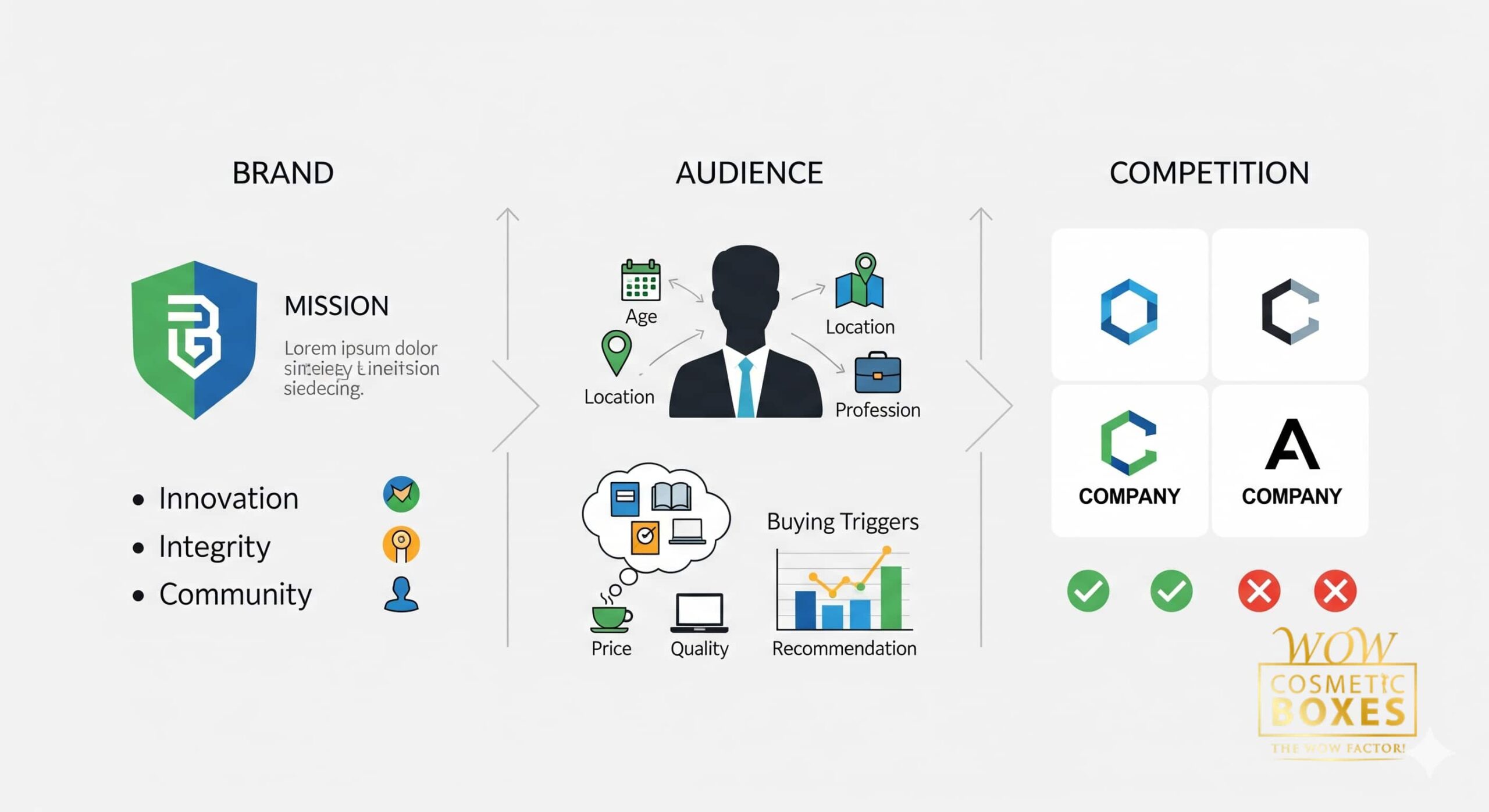
Before sketching dielines or choosing inks, define who you’re and who you’re speaking to. Start by clarifying values, mission, and benefits—define your product in one sentence.
Run market research to map demographics, preferences, and buying triggers. Build a customer persona to steer design elements: color systems, typography, tone, imagery.
Map demographics, preferences, and triggers. Craft personas to drive color, type, tone, and imagery.
Audit competitors to spot gaps and differentiate with clear messaging and brand consistency. Align the packaging design process to sales channels for visibility, readability, and compliance.
Translate insights into packaging solutions that signal value at a glance and guide action. Keep every panel intentional, every detail measurable, every choice audience-led.
To inform both creativity and costs, ensure your design includes precise package dimensions since accurate sizing is essential for pricing and protection in custom e-commerce packaging.
Choose Materials and Structural Packaging

Even as your brand story takes shape, lock in materials and structure that serve the product and the supply chain.
Start with packaging materials matched to product weight and fragility; balance durability with environmental impact.
Define structural design for functionality: stackability, tamper resistance, easy-open, and safe handling.
Evaluate custom packaging forms against packaging costs, cube efficiency, and fulfillment speed.
Verify legal requirements for materials and labeling early.
Partner with a packaging designer to translate constraints into performance.
Run prototype testing for drop, compression, and usability.
Iterate fast; document specs for vendors and QA.
- Protect what matters
- Waste less, ship smarter
- Open, use, smile
Choose recyclable substrates and consider eco-friendly boxes that support brand sustainability while reducing energy consumption and waste.
Craft Visuals: Color, Typography, and Imagery
Three levers shape shelf impact: color, typography, and imagery. Align color choices to desired consumer emotions: vibrant tones signal energy and excitement; earth tones cue naturalness and calm. Define consistent color schemes to lock brand recognition.
Color, typography, imagery: the trio that locks emotion, clarity, and instant shelf recognition.
Specify typography that’s legible and on-brand—clean sans serif for modern clarity, sizes prioritized for hierarchy and quick scan.
Use imagery that’s product-relevant and audience-specific to drive brand storytelling and a strong visual connection. Favor high-quality images or stylized graphics to elevate perceived value and add character.
Apply these elements cohesively across your packaging design system, ensuring instant identification in crowded retail contexts.
To elevate both aesthetics and performance, consider finishes like matte, glossy, or UV coating and embossed details that enhance tactile appeal while reinforcing premium brand perception.
Plan Production: Dielines, Printing, and Sustainability
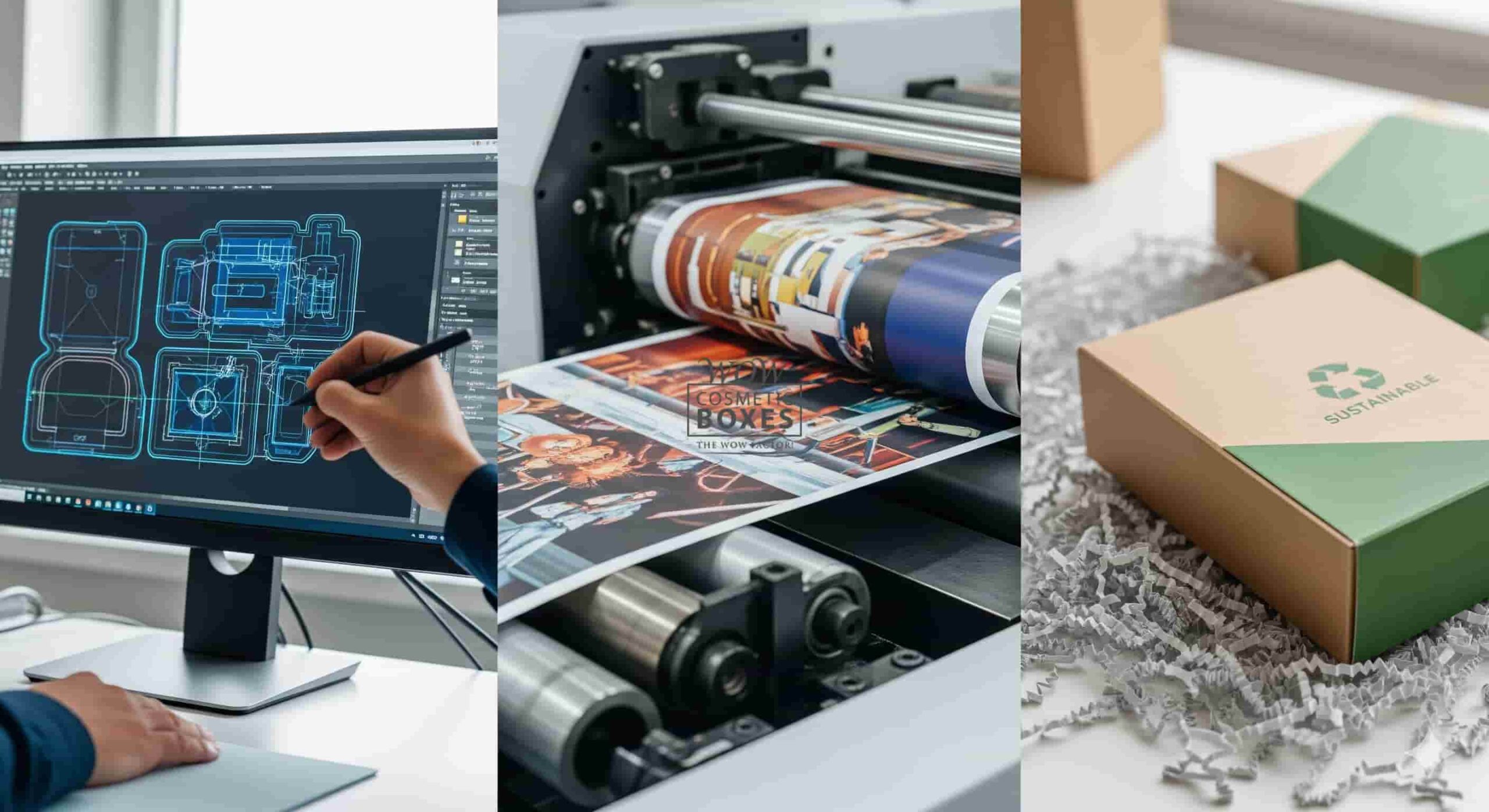
Your polished visuals only succeed on shelf if production matches intent. Lock dielines early; they define cut, fold, glue, and tolerances. Confirm file formats (PDF/AI), CMYK profiles, bleed, and dieline alignment to prevent production delays.
Vet printing methods—flexo, digital, litho—against run size, gradients, and spot colors. Engage printing partners to align capabilities with design choices and eco-friendly materials.
Prioritize sustainability using recycled paper, biodegradable films, or compostables; specify coatings and inks accordingly. Build packaging prototypes to validate fit, crush, and moisture performance.
Gather consumer feedback on ergonomics and disposal cues; iterate materials, gussets, and closures for clarity, durability, and minimal waste.
- Feel pride in responsible choices
- Trust your package’s integrity
- Delight in beautiful efficiency
Test, Iterate, and Prepare Files for Launch
Validate, iterate, and lock. Run durability tests that mimic drops, compression, humidity, and vibration. Capture failures visually; iterate your packaging design to reinforce weak edges, closures, and inserts.
Collect consumer feedback via polls and unboxing simulations; refine design elements for clarity, legibility, and delight.
Preflight files against printer specifications: dieline placement, bleed, CMYK/Pantone accuracy, overprint settings, vector logos, embedded fonts, linked images, and approved file formats.
Build a packaging style guide with color codes, fonts, logo rules, and imagery. Map a production timeline with revision gates and compliance checks.
Estimate packaging costs early; balance upgrades against unit economics before locking art for launch.
Frequently Asked Questions
What Are the 4 C’s of Packaging?
The 4 C’s of packaging are Consumer, Cost, Convenience, and Communication.
You map the Consumer: demographics, use context, visual cues. You control Cost: materials, formats, print runs, waste.
You optimize Convenience: easy-open seals, grip geometry, stackability, resealability, transport fit.
You sharpen Communication: hierarchy, icons, claims, regulatory, brand cues.
Prototype quickly, test with users, pressure-test in transit, and iterate to balance performance, price, sustainability, and shelf impact.
How to Get Into Product Packaging Design?
You get into product packaging design by building fundamentals fast: study materials, structures, dielines, and printing.
Learn Illustrator, mock up 3D renders, and reverse‑engineer retail boxes.
Create a tight portfolio: three case studies with process, CMYK files, and sustainability notes.
Research market trends, regulations, and the 4 C’s.
Network with printers and CPG designers, take briefs on Upwork, and iterate prototypes.
Document testing, costs, and recyclability to stand out.
Which App Is Best for Packaging Design?
Packify’s your best bet for packaging design. You’ll type prompts; it renders on-brand, balanced layouts fast in a flexible online studio.
Customize boxes, pouches, bottles without complex tools. Iterate with smart templates, adjust colors, typography, dielines, and export production-ready files.
Use built-in AI photography to generate polished product shots for mockups. You retain 100% design ownership for commercial use.
It’s precise, visual, and rapid from concept to shelf.
What Is the AI Tool to Design Product Packaging?
Packify is the AI tool to design product packaging. You type a descriptive prompt; it generates polished, on-brand visuals fast.
Use the online studio to tweak colors, typography, dielines, and mockups without complex software. Iterate with text-to-image variations, lock brand assets, and export production-ready files.
You keep 100% ownership for commercial use. It’s efficient, visual, and cost-saving, letting you prototype multiple packaging concepts in minutes instead of weeks.